3x to 5x faster use case deployment.
50-70% lower per-plant rollout cost.
Architecture blueprint in 12 weeks.
Even across globally distributed plant networks.
Our transformation service rebuilds your Industry 4.0 program around the architecture that compounds — so the second use case costs a fraction of the first, the tenth plant rolls out in weeks instead of quarters, and the AI capabilities you ship in year three actually generalize across the footprint you built in year one.
Conventional Industry 4.0 is use-case shopping, not architecture.
Every mainstream Industry 4.0 program starts the same way: identify use cases, prioritize by ROI, run pilots, scale the winners. It feels rigorous. It is structurally broken. Use-case-first programs treat each pilot as a standalone deliverable — its own data pipeline, its own vendor, its own platform. By the time the third use case lands, the first two have already locked in incompatible data schemas, contradictory integration patterns, and three vendor contracts that don't talk to each other. The fourth use case can't reuse anything from the first three. The fifth doesn't even get funded.
This is what pilot purgatory actually is — not a problem of poor execution but a problem of poor architecture. Conventional programs deliver a graveyard of disconnected POCs. They never deliver a platform. And without a platform, the AI capabilities every manufacturer now wants in their portfolio — predictive maintenance, vision-based quality, autonomous scheduling, demand sensing — sit on data that was never designed to support them.
The Architecture-First Method.
We invert the conventional sequence: architecture first, use cases second. Before a single pilot is selected, the data model, integration topology, platform layer, and governance model are designed so that every subsequent use case compounds the infrastructure rather than restarts it. The data captured by the first predictive maintenance pilot becomes the foundation of the next quality-vision deployment. The integration built for one plant becomes the template for the next twenty. The platform that runs one analytics workload runs the next thirty. The analysis is forward-looking: it prescribes the architecture for the next ten years of your industrial program, not a post-mortem on the last three.
Surgical clarity at five architectural layers.
Every recommendation lands at a specific architectural decision point — never a roadmap arrow, never a vendor logo on a slide:
The canonical data element — how every operational entity (order, work order, asset, defect, batch) is defined once and reused everywhere
The system interface — how MES, ERP, PLM, SCADA, IoT, and analytics platforms exchange that data
The platform topology — what runs in the cloud, what runs at the plant, what runs at the edge, and why
The use case — sequenced so infrastructure compounds rather than restarts, with each one ranked by both business value and architectural leverage
The rollout — which plant gets which capability in which order, calibrated to your global footprint, maturity, and constraints
No reference architectures. No "consider a unified data platform." Every layer carries an owner, an artifact, and a deployment date.
Lean engagement. Vendor-neutral. OT-safe.
The engagement runs without armies of consultants or multi-year transformation programs. Our tooling deploys inside your IT and OT environments — including air-gapped plant networks — works with your existing systems of record, and produces executable architectural artifacts: data models, integration specifications, platform topology diagrams, governance frameworks, plant-by-plant rollout sequences. Not decks. Your operational data never leaves your premises. Our recommendations are vendor-neutral by design — we don't take platform kickbacks, we don't resell stacks, and the architecture we prescribe optimizes for your industrial footprint, not for any vendor's commercial roadmap. This is a deliberate architectural choice, not an accommodation.
One architecture, every plant.
The systemic outcome is unification. Corporate IT, plant IT, OT, central digital, and the operating businesses all work from the same architecture — with function-specific work packages each can execute on their own clock. The data model becomes a shared vocabulary, the integration architecture becomes a shared contract, the platform topology becomes a shared substrate. Every new use case compounds prior investment instead of restarting it. Every new plant inherits the playbook rather than reinventing it. Every new AI capability rides on data that was already designed to support it. That is what makes 3×–5× use case acceleration and 50%–70% per-plant cost reduction possible. Without it, you get pilot purgatory. With it, you get compounding.
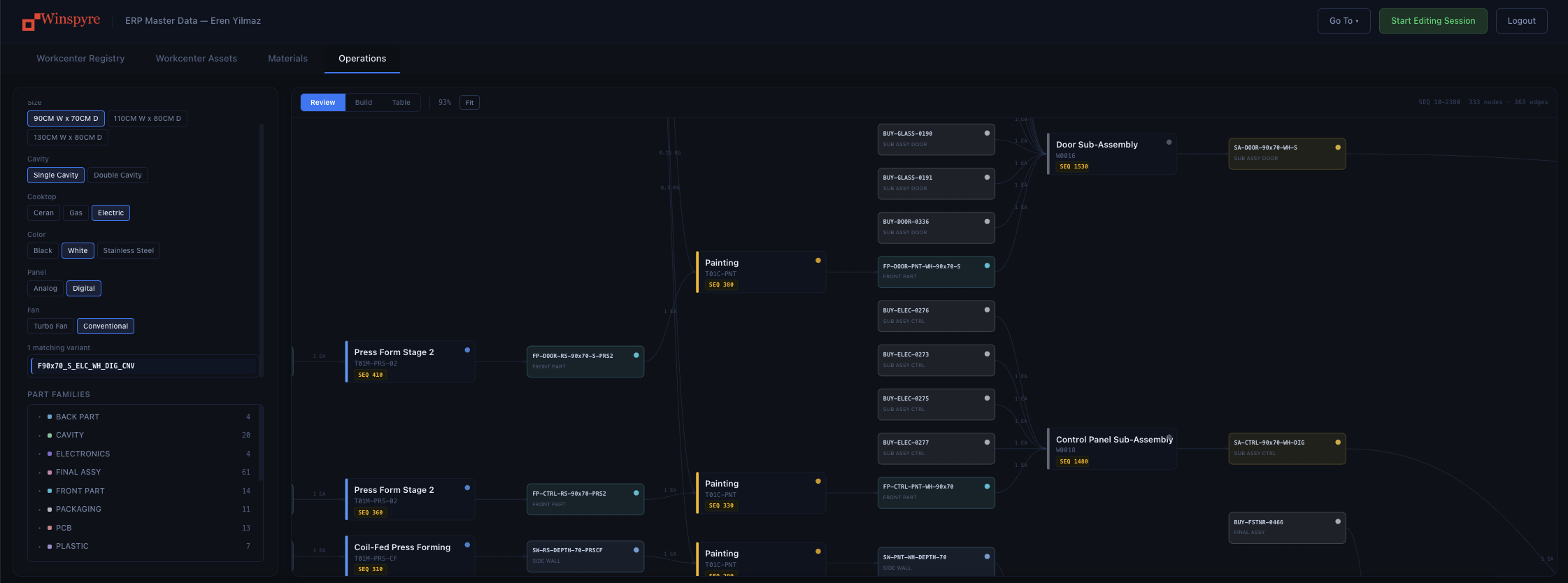
From the global supply network to the components of a single asset, from raw input to finished product — Winspyre renders the entire enterprise in one live, integral view.