
The emergence of programmable enterprises — and the threat to established industrial businesses.
Years ago, Esko Kilpi envisioned a firm of the future consisting of ten million people working together for ten minutes.
In 2023, I extended that proposition that firm of the future consisting of millions of humans, AI agents, robots, and vehicles working together for ten minutes.
Today, that future is emerging.
The physical economy is becoming programmable, while most industrial firms continue layering new technologies onto outdated business models and enterprise architectures.
Fourth-party logistics providers (4PLs) already abstract transportation and warehousing capabilities. Companies like Xometry, Protolabs, and Fictiv are making manufacturing capacity digitally accessible across distributed networks.
Imagine a small team using AI to design a product, generate engineering specifications and a bill of materials, source manufacturing capacity, coordinate logistics, sell through Amazon, and automate replenishment, pricing, and promotions.
Add programmable manufacturing technologies, and even mass personalization becomes possible.
The company no longer needs to own or permanently organize every capability required to deliver an outcome.
This is the great inspiration of cloud computing that most corporations missed.
Cloud was never fundamentally about moving servers elsewhere. It was about abstracting, aggregating, and making resources programmable.
Containers, Kubernetes, infrastructure-as-code, CI/CD, and now AI coding agents extended this logic throughout IT.
The same principle is now extending into the physical economy.
Yet most established enterprises continue to preserve their legacy architectures, functional silos, decision hierarchies, and operating models while incrementally adding new technologies.
More clouds. More integrations. More dashboards. More copilots. More agents.
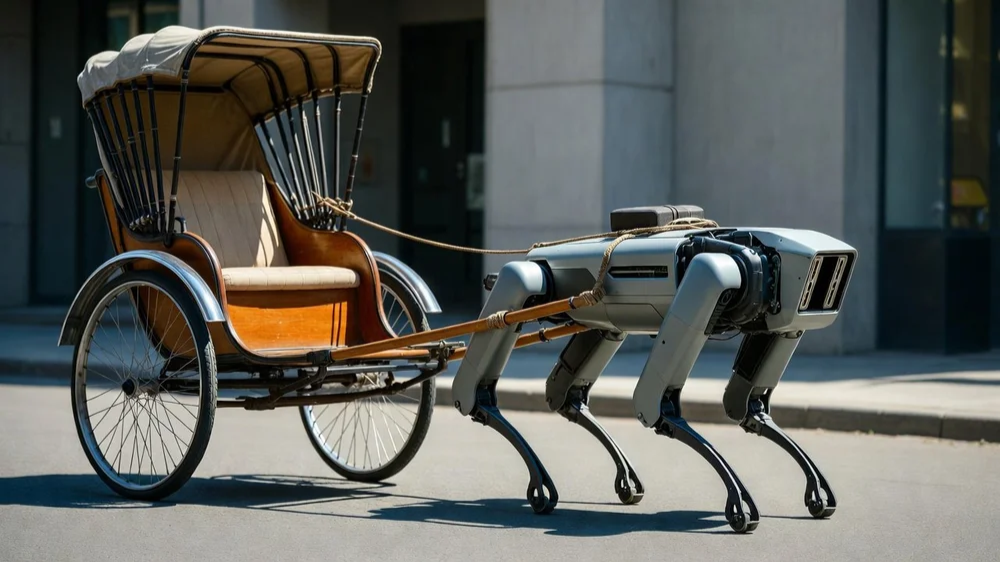
The result is often a technologically sophisticated Frankenstein — or a rickshaw pulled by a robot dog. And AI agents operating on top of fragmented systems may simply produce a faster, more autonomous Frankenstein.
Meanwhile, highly elastic competitors can dynamically assemble capabilities around outcomes without reproducing incumbents' organizational structures.
This is the real disruption.
The competitive advantage of the future may depend less on the size of the organization than on the complexity it can command.
Transforming Frankenstein into an Olympic gymnast cannot be accomplished by independently optimizing its parts.
Agility emerges from the coordinated behavior of the entire system.
At Winspyre, this is the principle behind our model-based approach: making the enterprise itself programmable, coordinated, and adaptive.
The cloud showed us how to abstract infrastructure. AI is showing us how to virtualize cognitive work. The next frontier is the programmable industrial enterprise.
And that requires transforming the architecture, not simply adding more technology.
© 2026 Winspyre Quant LLC. All rights reserved.