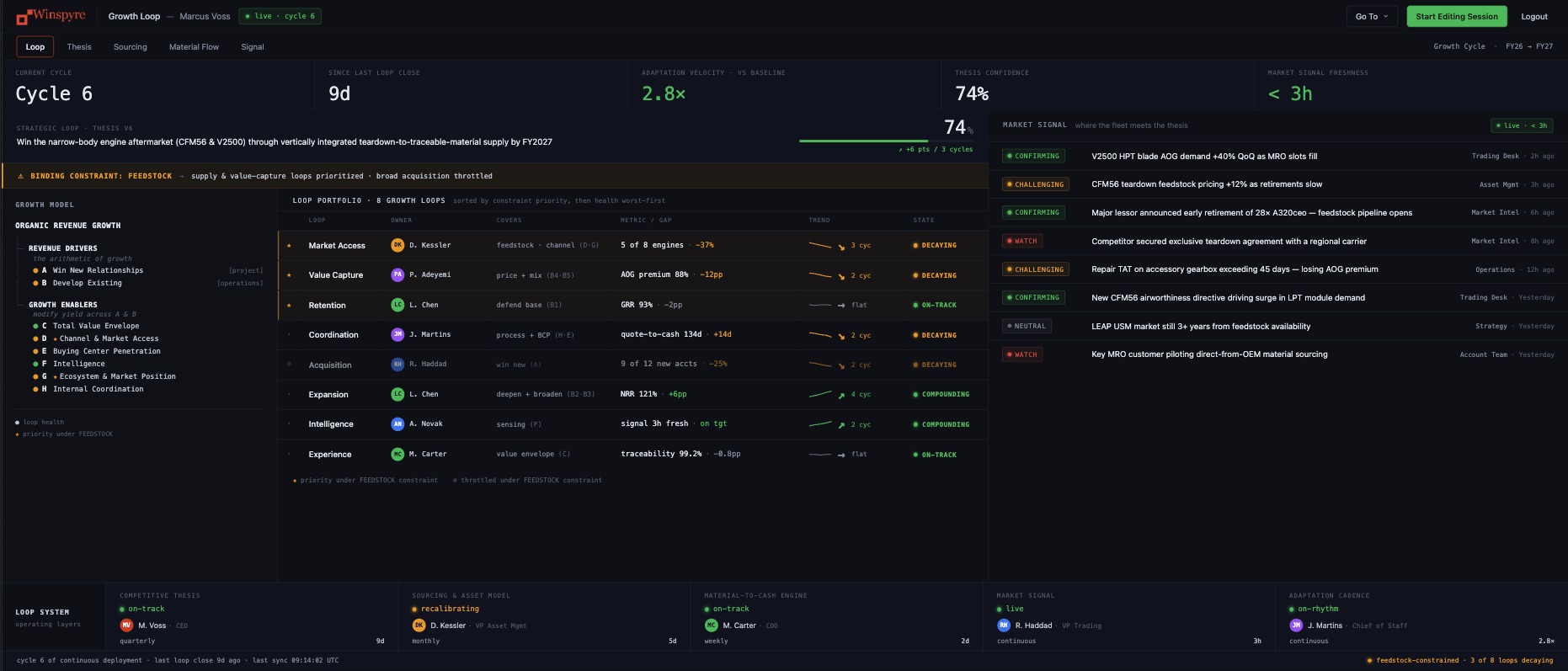
From annual strategy to continuous loop.
First closed cycle in 90 days.
3x faster strategic adaptation.
Even across multi-business-unit enterprises.
Our flagship growth service rebuilds the engine that connects strategy, business model, and field execution into a single closed-loop system — and produces a 90-day first cycle that proves the loop before most strategy engagements ship their first report.
Conventional growth strategy is open-loop.
Every mainstream growth program produces the same artifact: a strategic plan. A three-year horizon, a competitive analysis, a portfolio of initiatives, a phasing chart. Then it's handed off. The strategy team finishes; the operations team starts; the field starts executing. By month nine, reality has diverged from the plan, but nothing in the operating model brings that divergence back to the strategists. The strategy ages out without learning anything. The strategists move on; the executives schedule next year's strategy refresh; the cycle repeats.
This is what open-loop growth actually is. Not a problem of bad strategy or poor execution — a problem of structural disconnect between the two. The strategy phase doesn't see what the field learns. The field doesn't see what the strategy assumed. The business model gets designed once and is never recalibrated against what's actually working. Every quarter the gap between the plan and the reality widens, and the response — the next annual planning cycle — arrives too late and from the wrong altitude.
The Compounding Loop.
We replace the linear strategy → execution → measure handoff with a closed-loop system that runs continuously. Three phases — Innovate, Optimize, Evolve — feed each other in real time. The competitive thesis from Innovate becomes the operating model in Optimize. The operating model gets stress-tested by field signal in Evolve. The field signal refines the competitive thesis. The loop turns. Strategy stops aging out because it never stops being current. The business model stops drifting because it's continuously recalibrated. The field stops running on stale plans because the plan is always the latest learning.
Surgical clarity at five loop dimensions.
The closed-loop engine operates on five decisional layers. Each is owned, instrumented, and re-evaluated every cycle:
The competitive thesis — the specific testable bet about where growth lives (not "compete on quality," but "win the mid-market industrial segment through software-defined product differentiation by Q3")
The business model architecture — how the thesis monetizes at scale (revenue model, channel structure, capability anchors, cost structure)
The idea-to-cash engine — the operational machine that converts strategic intent into shipped revenue (commercial operations, pricing, R&D-to-launch, fulfillment, partner motion)
The field signal — the closed-loop feedback mechanism that brings operational reality back to strategy (win/loss data, customer expansion patterns, channel economics, frontline insight)
The adaptation cadence — the rhythm at which the loop completes (typically quarterly at the thesis layer, monthly at the model layer, weekly at the engine layer, continuous at the signal layer)
Each layer carries an owner, an artifact, and a measurable signal. No "develop a strategic vision." No "implement an operating model." Every layer is a continuous operation with a defined cadence.
Lean engagement. Continuously deployed.
The engagement is not a project — it is a deployment. Our tooling lives inside your strategic and operational environment, integrated with your existing planning, performance management, and CRM systems, and produces executable strategic artifacts: thesis documents, business model maps, idea-to-cash specifications, field signal dashboards, and loop cadence playbooks. Not decks. Your strategy, models, and field data never leave your premises. The loop is designed to run continuously after the first cycle proves it — without consultants resident, without licensing fees per cycle, without an annual re-engagement. We deploy the loop, leave you the engine, and stay available for periodic recalibration. This is a deliberate architectural choice, not an accommodation.
Strategy, operations, field — one closed loop.
The systemic outcome is unification. The C-suite, the strategy team, the business unit operators, and the frontline all work from the same loop — with phase-specific work packages each can execute on their own clock. The competitive thesis becomes a shared vocabulary, the business model becomes a shared architecture, the field signal becomes a shared scoreboard. Every loop turn compounds the prior cycle's learning instead of restarting the conversation. Every quarter's strategy is the previous quarter's learning materialized. Every operating decision sits in a loop that closes within weeks. That is what makes 3× strategic adaptation velocity possible. Without it, you get annual strategy decks and quarterly disappointment. With it, you get compounding.